What Makes China Best LED Displays Suitable for Stadiums?

Time:2026-09-18 Author:Aria
0%

China’s LED display industry has become a major force in modern stadium construction. Yet “best” should never mean the lowest price. It should mean dependable performance under bright sunlight, heavy rain, constant vibration, and demanding match schedules. This introduction examines what makes LED displays suitable for stadiums, from optical clarity to structural safety.

Stadium-display specialist Steve Scarbrough has observed, “A stadium display must serve the live moment, not merely decorate it.” That principle matters when a football replay appears across a giant screen. Fans must see sharp movement from distant seats. Players and officials need accurate information. Broadcasters also require stable color, high refresh rates, and flicker-free camera capture. These details separate a professional display from a large outdoor screen.

Chinese manufacturers often provide strong customization, competitive engineering, and extensive production capacity. Their displays can include high-brightness SMD LEDs, weather-resistant cabinets, redundant power systems, and front-service designs. A suitable product should also meet recognized electrical, electromagnetic, and safety requirements for its target market. IP65 protection helps resist rain and dust, but it does not remove the need for proper installation and maintenance. That is where judgment becomes important. Some suppliers promise impressive specifications, yet real performance may change after months of outdoor use. Buyers should inspect test reports, warranty terms, spare-parts planning, and completed stadium projects. A small weakness can become visible during a sold-out final. What makes LED displays suitable for stadiums is not one feature. It is the balance between visibility, resilience, serviceability, and verified reliability.
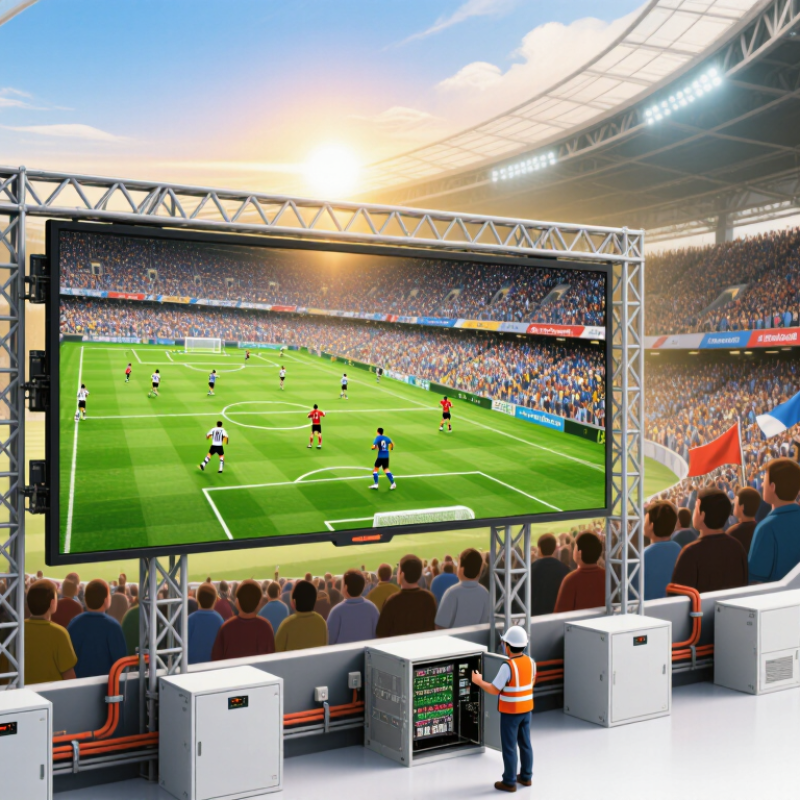
What Makes China Best LED Displays Suitable for Stadiums?

What Defines China’s Best LED Displays for Stadiums?

What defines China’s best LED displays for stadiums is not the country of manufacture, but measurable performance under pressure. Grand View Research valued the global LED display market at approximately USD 7.5 billion in 2023. Its forecast also shows continued growth through 2030. That growth raises expectations for stadium suppliers. High-quality systems should offer 5,000–8,000 nits for daylight visibility, while automatic dimming protects spectators during evening events. A 3,840 Hz or higher refresh rate reduces scan lines in broadcast footage. It matters when a slow-motion replay fills the screen.

Durability is equally important. The IEC 60529 rating system supports IP65 protection against dust and water jets for exposed display surfaces. Modular cabinets should include tool-friendly access, reinforced corners, and backup power for critical control components. Independent calibration is valuable. It keeps white balance consistent across thousands of pixels, even after repairs. MarketsandMarkets has projected the LED display market to grow from about USD 7.5 billion in 2022 to USD 11.1 billion by 2027. This expansion reflects demand for reliable, serviceable technology, not only larger screens.

A practical stadium test should examine glare, viewing angles, wind loading, latency, and maintenance time. Numbers can mislead. A brighter display is not automatically better. Poor thermal design may shorten component life, and excessive brightness can distract players. The best Chinese solutions combine documented testing, local service capability, and transparent warranty terms. I would still request a night demonstration before approval. Laboratory results rarely reproduce rain, dust, camera exposure, and crowded stands together.

How Stadium LED Displays Meet Visibility and Performance Needs

What Makes China’s Best LED Displays Suitable for Stadiums?

Stadium audiences need clear images from the front row to the highest seats. From the upper deck, small text and fast motion can quickly lose definition. High-quality LED displays help solve this problem with fine pixel spacing, wide viewing angles, and strong contrast. These details matter.

In practical stadium projects, engineers adjust brightness according to daylight, weather, and camera use. Excessive brightness can create glare for spectators and broadcast cameras. Insufficient brightness makes evening content look dull. Reliable displays use stable grayscale control, high refresh rates, and accurate color calibration. They should also maintain smooth images when athletes move rapidly across the screen.

Manufacturers in China offer extensive production experience for large-format LED systems. Many can provide modular cabinets, front or rear maintenance, and custom structures for curved stadium walls. Weather-resistant protection supports outdoor use, while thermal management helps control heat during long events. Backup power and signal paths can reduce the effect of individual component failures. Not every installation performs perfectly. Dust, uneven calibration, or poor ventilation can still reduce display quality. Careful testing on site remains essential. Technicians should inspect viewing angles, brightness consistency, cable safety, and content readability before a match begins. A display may look impressive in a showroom, yet reveal weak corners under real stadium lighting.

Which Technologies Improve Stadium LED Display Quality?

High-quality stadium LED displays depend on more than brightness. Their image quality comes from several technologies working together. Fine pixel pitch keeps player details sharp, even from nearby seats. High refresh rates reduce scan lines during fast camera movement and live broadcasts. HDR processing adds brighter highlights and deeper shadows, making night matches look more natural.

Automatic brightness control matters in changing stadium light. A display should remain visible under direct sunlight without causing uncomfortable glare after sunset. Anti-glare coatings and wide viewing angles help fans in corners and upper sections. Accurate color calibration also keeps team uniforms and field markings consistent across large screens. In practical testing, poor calibration is often more noticeable than a small resolution difference.

Tips: Check refresh performance with slow-motion footage. Inspect brightness from several seating levels. Ask for calibration records and weather-resistance tests. Front-service modules can reduce maintenance time, especially in crowded venues. Thermal monitoring and power redundancy improve reliability during long events. Still, no specification is perfect. Excessive brightness can waste energy, while an extremely fine pixel pitch may add cost without visible benefit at distant seats. A careful viewing-distance study should guide the final design.

How China’s LED Display Manufacturers Ensure Reliability

China’s LED display manufacturers focus on reliability because stadium screens face vibration, rain, dust, heat, and long operating hours. Field commissioning teams commonly check cabinet sealing, power stability, signal redundancy, and module consistency before installation. The International Energy Agency reports that modern LED systems can achieve very long service lives, but thermal stress remains a major limitation. A bright display still needs disciplined heat management.

Reliable factories usually combine automated placement with manual inspection. Each module may undergo brightness calibration, color testing, and extended aging before shipment. According to the U.S. Department of Energy’s Solid-State Lighting reports, LED components can support lifetimes exceeding 50,000 hours under controlled conditions. However, that figure does not guarantee complete display life. Fans, power supplies, connectors, and control cards can fail earlier.

Testing must resemble the stadium environment. Manufacturers often use IP-rated cabinets, thermal cycling, vibration checks, and water-spray tests based on IEC 60529 principles. They also monitor refresh rates and grayscale performance, since camera flicker can damage live broadcasts. Some factories add spare modules and dual power paths for faster maintenance. This matters during a match.

Yet reliability claims deserve careful review. A factory certificate cannot replace installation records, aging data, or independent inspection. Oversized brightness settings may shorten component life. Poor ventilation can quietly increase failure rates. China’s strongest manufacturers provide traceable test reports, batch numbers, wiring diagrams, and onsite service procedures, although documentation quality still varies between suppliers.

These reference targets reflect commonly specified requirements for outdoor stadium LED displays: high brightness for daylight visibility, fast refresh for broadcast cameras, long rated LED lifetime, and weather protection based on IEC 60529 ingress-protection classifications. Actual project specifications vary by venue, climate, and viewing distance.

What Factors Guide the Selection of a Stadium LED Display?

What Makes China Best LED Displays Suitable for Stadiums?

Selecting a stadium LED display starts with the audience, not the cabinet. Measure both the nearest and farthest seats before choosing pixel pitch. A screen that looks sharp in a showroom may appear soft across a wide seating bowl. High refresh rates support slow-motion replays and reduce camera scanning lines. A 3,840 Hz specification helps, but broadcast-camera testing remains essential. No number replaces testing.

Brightness, contrast, viewing angle, and weather resistance guide outdoor performance. IP65 protection is often suitable for dust and water exposure, but drainage and cabinet sealing still require inspection. The U.S. Department of Energy reports that LED lighting can use at least 75% less energy than incandescent lighting and last up to 25 times longer. That figure does not describe every LED display. Power consumption must be measured under real content, not only laboratory conditions.

Reliability also depends on service access, spare modules, calibration, and control-system compatibility. Grand View Research’s 2024 digital signage analysis projects an 8.1% compound annual growth rate through 2030, reflecting wider demand for connected visual communication. Buyers should compare total ownership cost, not only purchase price. Engineers should request thermal tests, waterproofing records, electromagnetic compatibility documents, and several hours of live replay. A common mistake is trusting a polished specification sheet. Field conditions are less polite.

What Makes China Best LED Displays Suitable for Stadiums? - What Factors Guide the Selection of a Stadium LED Display?

Selection Factor Practical Specification Why It Matters in a Stadium What to Verify Before Purchase
Pixel Pitch Typically 4–10 mm for perimeter boards and 6–16 mm for large-format scoreboards, depending on viewing distance. A smaller pixel pitch improves close-range image detail, while a larger pitch can reduce cost and power consumption when the audience is far away. Match the pitch to the nearest viewing distance, screen size, camera requirements, and content type.
Brightness Outdoor displays commonly require approximately 5,000–8,000 nits; indoor displays generally need much less. High brightness keeps text, graphics, and live video visible under direct sunlight. Automatic brightness control helps prevent excessive glare at night. Confirm measured brightness, daylight visibility, night-mode performance, and the presence of an ambient-light sensor.
Refresh Rate At least 3,840 Hz is commonly selected for sports venues; 7,680 Hz may be preferred for demanding broadcast applications. A high refresh rate reduces flicker and scan-line artifacts in television, livestream, and slow-motion footage. Request camera test footage at different shutter speeds and verify compatibility with the venue’s broadcast workflow.
Weather Protection For exposed outdoor surfaces, IP65 protection on the front is a common minimum; the rear rating depends on cabinet location and enclosure design. Dust, rain, humidity, and cleaning procedures can affect LEDs, power supplies, receiving cards, and connectors. Review ingress-protection test documentation, drainage design, corrosion resistance, and operating temperature limits.
Viewing Angle A horizontal viewing angle of approximately 140° or wider is useful for perimeter and corner installations. Wide viewing angles help spectators seated across different sections see consistent brightness and color. Check brightness and color consistency from side seats, not only from the centerline.
Color and Image Quality Use calibrated RGB LEDs with consistent white balance, grayscale performance, and stable color reproduction. Accurate color is important for team graphics, advertising, replay video, and live event presentation. Evaluate grayscale images, skin tones, fast-motion video, black levels, and uniformity across the complete screen.
Viewing Distance and Screen Size Select the display area and pixel pitch together; a common planning rule is that minimum viewing distance increases as pixel pitch increases. The correct combination prevents unnecessary spending on excessive resolution while maintaining readable scores and smooth video. Prepare a sightline study covering the nearest seats, farthest seats, camera positions, and obstructed viewing zones.
Mechanical Safety Use reinforced cabinets, secure locking systems, protective masks or soft modules for perimeter boards, and certified mounting structures. Stadium displays may be exposed to ball impact, vibration, wind loads, crowd activity, and frequent installation work. Confirm structural calculations, impact protection, wind-load limits, emergency access, and compliance with local building codes.
Perimeter Board Safety Sports-field perimeter displays should use flexible protection, suitable tilt angles, and a lower installation height where required. These measures help protect players and reduce the risk of injury during collisions near the field boundary. Verify padding, cabinet angle, edge treatment, installation clearance, and the venue’s sports safety requirements.
Power Efficiency Specify maximum and typical power consumption, with brightness control and energy-saving operating modes. Large stadium screens can consume substantial electricity, particularly at high brightness and during long events. Compare measured power data, circuit requirements, heat output, and generator or backup-power capacity.
Maintenance Access Front-service modules are valuable where rear access is limited; quick-release modules reduce replacement time. Fast maintenance minimizes downtime and avoids dismantling seating, advertising structures, or other venue equipment. Inspect module replacement procedures, spare-part access, maintenance tools, and service clearance.
Control and Redundancy Use reliable control systems with signal monitoring, backup power options, and redundant data paths for critical displays. Redundancy reduces the chance that a single failed component will interrupt scoring, advertising, or live-event content. Test backup signal switching, controller recovery, remote monitoring, and fault alerts before acceptance.
Content Compatibility Support the required input resolutions, aspect ratios, frame rates, live feeds, scoreboard data, and advertising schedules. A display is only useful when it integrates smoothly with replay systems, scorekeeping software, cameras, and venue networks. Run a full workflow test using live video, replay, scores, sponsor content, emergency messages, and multilingual text.
Operating Temperature Select components and cooling systems rated for the venue’s lowest and highest expected temperatures. Thermal stress can shorten LED, power-supply, and control-system life and may cause brightness or color instability. Review temperature ratings, ventilation, heat dissipation, condensation control, and thermal monitoring.
Service Life and Support Plan for long-term availability of LED modules, power supplies, receiving cards, cables, and technical support. A stadium installation is a long-term asset, and unavailable replacement parts can create costly downtime. Define warranty terms, spare-parts quantities, response times, software support, training, and preventive-maintenance procedures.
Note: The recommended specifications are general planning ranges. Final requirements should be confirmed through a site survey, viewing-distance analysis, structural assessment, local regulations, and the stadium’s broadcast and event-production needs.

FAQS

Why are fine pixel spacing and wide viewing angles important in stadium LED displays?

Fine pixel spacing keeps player faces, numbers, and small text clearer. Wide viewing angles help fans in corners and upper seats.

How should brightness be adjusted for different stadium conditions?

Engineers should balance sunlight, weather, and camera use. Excessive brightness creates glare, while low brightness makes evening images look dull.

What display features support live sports broadcasts?

High refresh rates reduce scan lines during fast camera movement. Stable grayscale control and accurate colors help preserve natural images.

How can HDR processing improve a stadium viewing experience?

HDR creates brighter highlights and deeper shadows. Night matches may look more realistic, especially around floodlit fields.

Why is automatic brightness control useful?

Stadium lighting changes quickly from afternoon sun to evening darkness. Automatic adjustment can maintain visibility without uncomfortable glare.

What weather and maintenance features should stadium displays include?

Weather-resistant protection supports outdoor use. Front-service modules can shorten maintenance time in crowded venues. Thermal management also helps control heat.

How can a stadium reduce the impact of component failures?

Backup power and separate signal paths can limit interruptions. They do not remove every risk. Testing remains necessary.

What should technicians inspect before a match begins?

They should check viewing angles, brightness consistency, cable safety, ventilation, and content readability. Slow-motion footage can reveal refresh problems.

Is the finest pixel pitch always the best choice?

Not always. Very fine spacing may increase cost without visible benefits for distant seats. Viewing distance should guide the design.

Why can a showroom display perform differently inside a stadium?

Real stadium lighting may expose uneven calibration, dust, weak corners, or poor ventilation. A polished showroom test is not enough.

Conclusion

China’s best LED displays for stadiums are defined by high brightness, sharp image quality, wide viewing angles, and reliable performance in changing outdoor conditions. What makes LED displays suitable for stadiums is their ability to deliver clear live footage, scores, advertisements, and instant replays to audiences across large venues, even under strong sunlight or from distant seats. Fine pixel spacing, accurate color reproduction, fast refresh rates, and strong contrast help ensure smooth, detailed visuals for both spectators and broadcast cameras.

Stadium LED displays must also withstand dust, moisture, vibration, temperature changes, and long operating hours. Manufacturers improve reliability through durable cabinets, efficient heat management, protected components, stable control systems, and strict quality testing. When selecting a display, stadium operators should consider screen size, viewing distance, installation position, weather resistance, energy efficiency, maintenance access, control flexibility, and long-term operating costs. A well-designed solution balances visual impact, safety, durability, and practical management needs.

Aria

Aria

Aria is a dedicated marketing professional with a deep passion for innovative strategies and a keen understanding of our company's product offerings. With a wealth of experience in the industry, Aria excels at crafting engaging content that highlights the unique features and benefits of our......